Financial institutions often operate large existing technology estates while https://www.webcyclopedie.com/what-are-the-benefits-of-cloud-storage-for-personal-use/ facing requirements around data residency, security, resilience, and auditability. Identify bandwidth, latency, resilience, and security requirements between environments. AWS’s current hybrid guidance organizes architecture recommendations around networking, security, resilience, capacity planning, and infrastructure management. Conventional on-premises infrastructure may include physical servers, legacy software, appliances, and […]
Financial institutions often operate large existing technology estates while https://www.webcyclopedie.com/what-are-the-benefits-of-cloud-storage-for-personal-use/ facing requirements around data residency, security, resilience, and auditability. Identify bandwidth, latency, resilience, and security requirements between environments. AWS’s current hybrid guidance organizes architecture recommendations around networking, security, resilience, capacity planning, and infrastructure management. Conventional on-premises infrastructure may include physical servers, legacy software, appliances, and databases without cloud-style orchestration.
This comprehensive approach allows organizations to optimize their IT resources to effectively meet diverse business needs. By integrating these components, a hybrid cloud environment combines the flexibility and scalability of public cloud services with the control, security, and compliance of private infrastructure. Colocation facilities (colo) extend data center capabilities without requiring physical infrastructure expansion, providing high levels of security, redundancy, and connectivity.
Containers are lightweight because they share the machine’s operating system (OS) kernel, meaning each container holds just the microservice and its dependencies. Microservices are an approach in which an application is broken into smaller components or services for easy deployment. The the recent past, a hybrid cloud approach typically involved migrating some services from on-premises infrastructure to a public or private cloud, and these services communicating with each other. At the basic level, this could just be an enterprise hosting legacy applications on its on-premises data centers—invoking a few APIs on public cloud services. Unify on-premises, private and public cloud environments — open, scalable and secure infrastructure that lets you run workloads where they make the most sense.
Scalable Application Deployment
Enterprises increasingly rely on the hybrid cloud to address critical business and IT challenges while optimizing their operations. With the rise of GenAI and AI workloads, http://web-promotion-services.net/GoogleAds/how-to-buy-google-ads enterprise hybrid clouds are essential for future-ready IT strategies. As hybrid multi-cloud becomes the dominant IT model, driven by data gravity, governance, privacy, and performance needs, 88% of enterprise IT environments are now hybrid.
Look for the ability to set up a central dashboard that offers visibility into all elements of the hybrid infrastructure—this is critical for effective management. An example is security, where an in-house team might set certain standards and a cloud provider might be accountable for implementing and monitoring to those standards. The growing range of hybrid deployment model options available lets companies align this mix of cloud and on-premises services even more closely with their needs. If they have a certain application or workload that’s particularly unforgiving of latency, and their operations aren’t located close enough geographically to a cloud data center to remove that lag, keeping the system onsite makes sense. While they may decide to move many applications to SaaS—such as ERP, human resources, and CRM apps—there are often niche or custom legacy applications that they decide to leave on-premises and that must communicate with their cloud systems. Some intend for the mix of cloud and on-premises resources to be temporary as they incrementally move computing workloads to one or, more likely, multiple public cloud providers.
Building a Hybrid Cloud
This critical hybrid cloud feature known as “cloud bursting” supports companies with sudden surges in computing demand like online retailers, who often use cloud bursting to support increased traffic during flash sales. As cloud computing for business took hold, and the need for digital transformation increased, organizations began turning to hybrid cloud solutions to control costs and improve overall agility. Hybrid cloud architecture refers to an environment that combines on-premises, private cloud, public cloud and edge settings to create a single, flexible managed IT infrastructure. This gives organizations deep insight into the observed data, with precise root-cause analysis of anomalies for proactive problem resolution. The solution starts with observability, enabling organizations to measure the system states based on their logs, metrics, and traces. To address hybrid cloud complexity, organizations need to make sense of the data coming from their platforms and services.
While they may decide to move many applications to SaaS—such as ERP, human resources, and CRM apps—there are often niche or custom legacy applications that they decide to leave on-premises and that must communicate with their cloud systems.
A financial institution can keep regulated records under tightly controlled infrastructure while using cloud services for digital applications or analytics.
Others need local data access, existing infrastructure, specialized hardware, lower latency, or tighter control.
A homogeneous model consists of private and public offerings—on-site or off-site—from a single vendor.
System managers will still use the vendor’s tools in each environment to configure and troubleshoot each element of the hybrid cloud.
Built to operate only in the cloud, cloud-native applications are designed by DevOps and other teams to be scalable and are comprised of microservices (also called microservices architecture).
A company can keep a core application on-premises while building new APIs, analytics, or customer applications in the public cloud.
Multiple environments can create more options for recovery and redundancy.
Together, these components form a robust hybrid cloud infrastructure that balances performance and cost.
Public cloud computing resources can include software-as-a-service applications, such as ERP or CRM apps, or infrastructure as a service and platform as a service, such as compute, storage, databases, and development environments.
After deployment, IT teams can also optimize the software and supporting hardware to ensure high performance. Teams can then install orchestration tools locally, or platforms can deliver them as a managed service. Altogether, these platforms offer specialized capabilities that give organizations the flexibility to integrate powerful, extensible cloud services with their on-premises assets. Organizations can keep sensitive information in-house with strict user controls and enhanced security. A multicloud architecture typically involves a mix of services from multiple public cloud vendors.
What are the benefits of hybrid cloud?
It depends how your IT team sets up your architecture, of course, but it’s possible to still use VMware as an IT resource management tool while moving to a hybrid cloud model using both on-premises servers and public cloud servers. Companies often use a multicloud strategy as part of their hybrid cloud approach, combining an on-premises data center with more than one public cloud. You could even choose an OCI Dedicated Region, which puts a complete OCI cloud region in your data center, applying the degree of isolation you need to help you meet governance, regulatory compliance, and data privacy requirements. Oracle Cloud Infrastructure (OCI) is unique in its ability to meet a broad spectrum of requirements, where hybrid is just one deployment modality. Hybrid clouds can range from the very simple, such as an environment connecting a https://www.xserver-jp.net/the-hosting-evolution-how-modern-server-infrastructure-is-reshaping-digital-business/ cloud ERP with an on-premises inventory system, to the complex—for example, a sophisticated multicloud environment running a wide range of computing workloads. There will be a security layer between internal and external systems, which must be factored into a management plan.
Some in-house IT teams use a software layer not from the public cloud provider, such as VMware, to manage compute, storage, and networking across locations and clouds. Major cloud providers offer hybrid management systems that let IT teams look at the performance of both their public cloud environments and their on-premises systems within certain parameters. Some companies are comfortable letting many or even most applications and databases live in the public cloud, but certain customer data or product development information, for example, might need to stay on-premises, either by regulation or company policy. In addition, HPE offers unified hybrid cloud operations, giving customers the same management experience for their entire IT estate. The distribution of workloads is done strategically; scalable tasks, like as web applications or testing, benefit from of the flexibility of public clouds, while sensitive or compliance-heavy workloads reside in private clouds for superior control and security.
Nagarkot is also the perfect destination for practicing Yoga and meditation. The calm setting, panoramic vistas, lush greenery in the surroundings, and fresh air are unspoiled setups for yoga and meditation. For rejuvenation, indulge in yoga and meditation activities.
Nagarkot is the perfect closest destination from the capital for relaxation and to spend quality time with family or loved ones. Just a few kilometers away from Kathmandu, Nagarkot is an ideal destination to simply sit, relax, and enjoy amidst the peaceful ambiance. Spend time adoring mountain vistas, and surroundings.
The vicinity of Nagarkot is abundant with greenery and an ideal habitat for diverse flora and fauna. The diverse bird species such as raptors and migratory birds are some prime attractions here. Bird-watching in this serene environment and identifying, and observing can be a fun activity.
The natural surroundings in the Nagarkot look dreamlike. The scenic landscapes, mountain vistas, attractive villages, terraced fields, sunrise views, local culture, and ancient cultural heritages are the best visuals for any photography lover. Capture the best sightings and set them for the best memories.
Mountain Biking is one of the adventurous sports which can be explored on the Nagarkot trails. Adoring the beautiful landscapes, and picturesque views, mountain biking lovers can go for this exciting adventure on the popular ‘Loop Route’. Rent the bikes for this mountain biking adventure.
Sightseeing to nearby peaceful but beautiful Buddha Peace Park by an hour’s walk is a pleasant experience. The Grand Golden Buddha statue that overlooks the beautiful valley is not to be missed. An entry fee is required to get here. Planting a sapling in the memory of your loved ones is one of the best […]
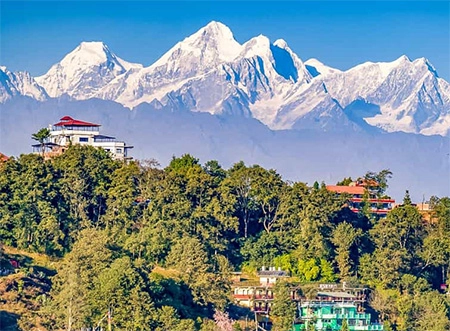
Sunrise view is the best attraction of the Nagarkot. The sunrise view over stunning Himalayan ranges from the Nagarkot View Tower is captivating. The panoramic Himalayan views including the world’s highest Mt. Everest on a clear day are a treat to watch. We assure you the sunrise viewing is sure to enchant you and will […]
Nagarkot is far from the hustle and bustle of the city. The tranquil environment with scenic landscapes is a perfect getaway. The village tours in Nagarkot are one of the best ways to immerse yourself in the culture, tradition, and lifestyle of local ethnicities. The naturalness of the village is the prime highlight.
Nagarkot hiking trails also popular as the Panoramic Trail encompasses the Nagarkot Nature Trail. Nagarkot-Changu Narayan Trek, Nagarkot-Sankhu Trek, Nagarkot-Namo Buddha, etc. are some of the famous hiking destinations. Walk through the trails of lush green forest, and terraced fields, admiring the natural beauty of the environment in a peaceful setting. A guide is optional […]
About Nagarkot
Nestled 32 kilometers east of Kathmandu, Nagarkot is a picturesque hill station, offering awe-inspiring aerial views of Nepal’s major Himalayan peaks, including the iconic Mt. Everest. Situated at 2175 m above sea level, this enchanting destination captivates visitors with its pristine beauty and panoramic vistas of the Himalayas ...